

Data Blackout: Another Government Shutdown Looms To Start 2026, Allowing The Trump Administration To Not Report Key Statistics
Anything to divide, distract, and blot out the collapse, the government and the media will do it.

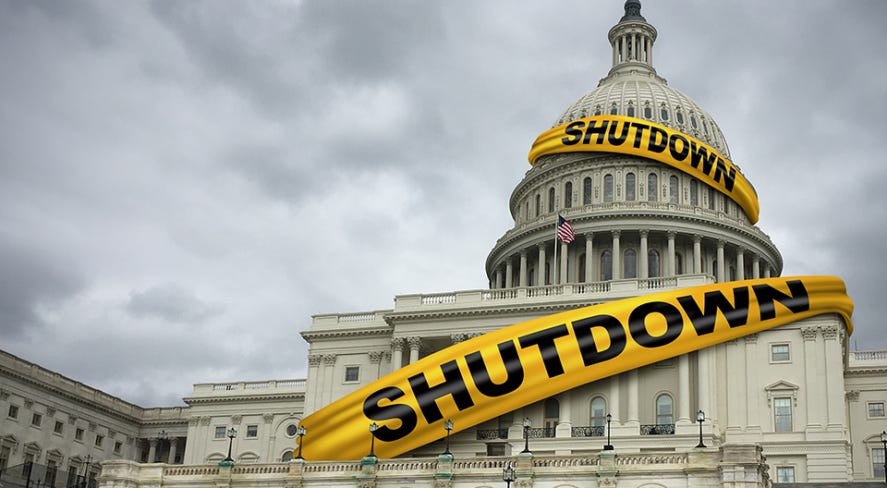
The United States is primed for yet another government shutdown and all the circus acts that come with it.
Back in November, you may recall we covered how a temporary stopgap resolution was signed to end the longest shutdown in U.S. history.
I wrote:
However, the resolution is just another temporary stopgap funding bill that will only last heading into January 2026, meaning there is a strong possibility that the government will shutdown again to start the new year, and the cycle will repeat itself. Of course, the politicians in Washington were finally motivated a little to temporarily end the shutdown for fear of major travel delays with airlines forced to wave flights right before Thanksgiving and the holiday season; and that, of course, would also interfere with the politicians’ travels, and that simply can’t be. Priorities. That, and the SNAP debacle, was starting to weigh heavily on both sides of the aisle as states, cities and counties were forced to get involved - and will probably have to continue to chip in moving forward.
Right when the shutdown began on the first of October, I explained how this shutdown was being used as an excuse for the government to not have to report key statistics and data, and government contracts, important minutes and transcripts, and other information that would normally be published.
Mainstream media was already front-running this ahead of the shutdown; and I had joked, There’s no crash if they don’t report it, right?
Sure enough, this ended up being the case. The administration confirmed in November that even after the shutdown ended, they stated they were not going to release the October jobs and inflation reports.


Again, I wrote at the time:
Ah yes, the party of transparency and honesty is now withholding public data, what a shock. Sure, we all know that the data is fudged in the government’s favor anyway, but still… Of course, Jerome Powell and the Federal Reserve often claim they are “data dependent,” yet they cut interest rates not that long ago and will in all likelihood cut again one more time this year without the necessary data. It’s all just a sham all around.
So it appears this will be the ‘new normal’ where the government is giving itself convenient excuses and alibis to not have to report critical public data, press releases, minutes, and contracts.
Don’t fall for the right vs. left stuff. This is a collective effort to give themselves, and those in the government, justification to do things they normally could not get away with while the country bleeds out from within, by design, and keep Americans even more in the dark as to their nefarious deeds.
Well, it appears all that and more is set to return to start 2026.
Here is some of the script from the latest episode of The Days of our Lives Corrupt Government - from Politico (written on Dec. 22nd):
Congress has adjourned for the holidays having made no tangible progress toward funding the government ahead of a shutdown looming less than six weeks away.
The most conspicuous sign that Congress faces real obstacles before the Jan. 30 funding deadline came late Thursday, when Senate leaders gave up on passing a spending package and sent members home for two weeks, despite working for more than a month to appease senators who had objections.
But the impediments to reaching a deal that can pass both chambers are more extensive, starting with the fact that Republicans and Democrats on both ends of the Capitol have yet to start negotiating the details of the nine pending funding bills. The lack of bipartisan offer-trading is raising the likelihood of another short-term punt — or another shutdown.
“We wasted a lot of time because the Senate’s not negotiating yet,” House Appropriations Chair Tom Cole (R-Okla.) said in an interview last week. “When they’re ready to negotiate, we can move fast.”
[…] Even if top appropriators can manage to agree on the nine remaining funding bills, other thorny dynamics threaten to complicate final passage in each chamber. The pitfalls include the mismatch between what appropriators want to spend and the demands of House fiscal hawks seeking flat funding for agencies — as well as the fact that Democrats will need to help pass any spending bills in the Senate, as they acutely illustrated with this fall’s record 43-day shutdown.
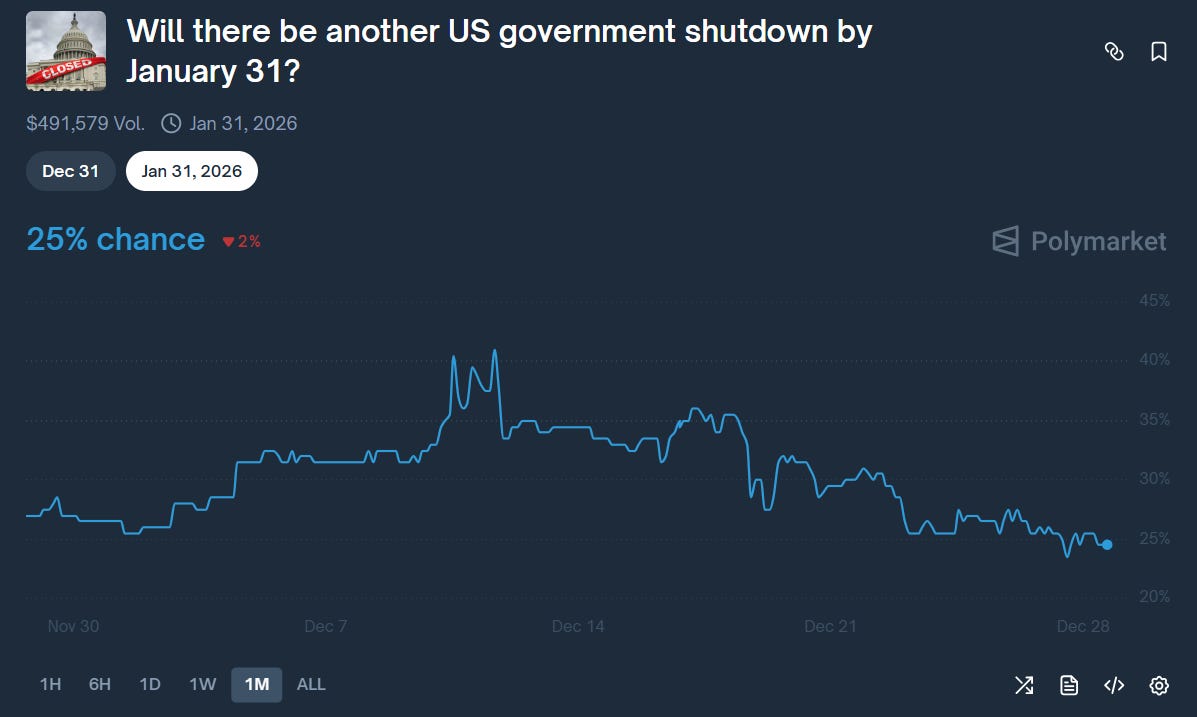
[…] Last week, [House Speaker Mike] Johnson told his conference in a closed-door meeting that he wants to pass those bills by the Jan. 30 deadline — a goal that many in the GOP ranks consider aspirational at best. One House Republican granted anonymity to describe the private meeting said he turned to one of his colleagues and whispered, “I wouldn’t bet on that on Polymarket,” referring to an online prediction market.
[…] But it was Democrats who blocked movement in the final days before the Senate adjourned Thursday. One late-breaking demand by Colorado’s senators was to reverse the White House’s move last week to dismantle a federal center in the state that supports research in climate and weather science.
[…] When Congress reconvenes, both chambers are only scheduled to be in session for three weeks before the shutdown deadline — with the House slated to be out of session the week immediately before.
So get ready for more nonsense and drama. But I could care less about that; I am more intrigued by the data blackout that is intentionally going to be created, again, and will probably become the ‘new normal’ indefinitely. Shutdown for a month or two, essential services get delayed and backlogged which in turn affects their lives, and then like magic they will reach a resolution, and kick the can down the road for a couple of months and restart the process all over again.
Anything to divide, distract, and blot out the collapse, the government and the media will do it.

Jeremiah 8:15 We looked for peace, but no good came; and for a time of health, and behold trouble!
The Lord Of Glory: The Detailed Guide To Who God Is – Available Now!

On one of his missionary journeys, the apostle Paul visited Athens, Greece, where he said he witnessed “the city wholly given to idolatry,” and who were “too superstitious” and worshipped a plurality of gods and deities, though the people acknowledged that there was still one God above all that was a mystery to them. When questioned by the philosophers …
[7] Who goeth a warfare any time at his own charges? who planteth a vineyard, and eateth not of the fruit thereof? or who feedeth a flock, and eateth not of the milk of the flock? [8] Say I these things as a man? or saith not the law the same also? [9] For it is written in the law of Moses, Thou shalt not muzzle the mouth of the ox that treadeth out the corn. Doth God take care for oxen? [10] Or saith he it altogether for our sakes? For our sakes, no doubt, this is written: that he that ploweth should plow in hope; and that he that thresheth in hope should be partaker of his hope. (1 Corinthians 9:7-10).
The WinePress needs your support! If God has laid it on your heart to want to contribute, please prayerfully consider donating to this ministry. If you cannot gift a monetary donation, then please donate your fervent prayers to keep this ministry going! Thank you and may God bless you.
Solid analysis on the data blackout pattern. The most concerning part isn't the shutdown itself but how it's becoming a convienient mechanism for selective transparency. Once governments normalize withholding routine statistical releases during 'crisis' periods, that toolkit stays available for future use. I dunno if people realize how much policy debate relies on timely data, when BLS or Census reports go dark for weeks, it creates an informaton vacuum that gets filled with speculation and narrative rather than facts.
This analysis nails it, the pattern of using shutdowns as cover for data blackouts is getting predictable. What's wild is how the Impoundment Control Act angle keeps getting ignored when these funding gaps happen, like there's no legal framework that's supposed to prevent exactly this kind of selective reporting pause. I worked briefly with state-level budget offices a while back and even at that level the pressure to delay bad news reporting is immense, so at federal scale with tens of billions at stake this probably becomes standard operating procedure rather than exception.