

Huawei Introduces 5.5G Technology: Augmented Reality, Automation, And Advanced AI, Paving The Way For 6G
"5.5G is expected to support connectivity for up to 100 billion devices, paving the way for smart cities, automated industries, and advanced Internet of Things (IoT) applications."

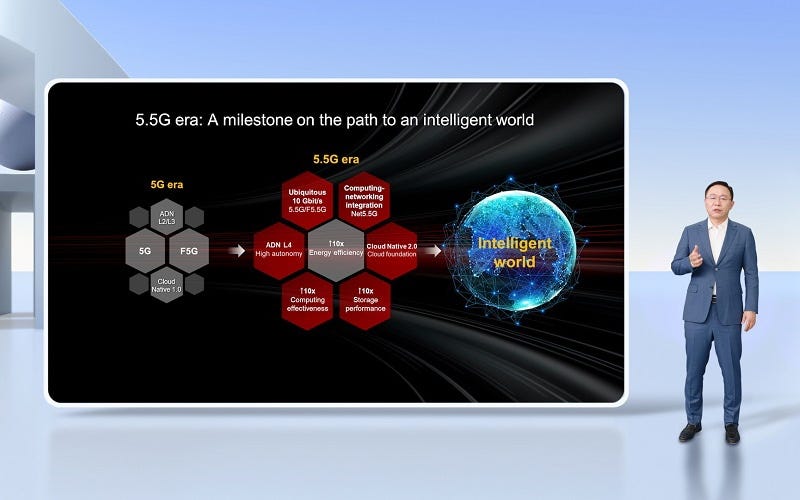
The following report was first published on July 4th, 2024, on winepressnews.com.
Chinese technology and telecommunications company Huawei quietly unveiled what they call “5.5G” technology, a subset of a generational technological rollout before the world eventually reaches 6G.
Essentially, 5.5G ushers in augmented reality and metaverse technologies, coupled with and powered by complex artificial intelligence systems, allowing for real-time analytics via smart grids and automation of factories and work. This allows for faster streaming and download speeds, such as being able to stream 4K quality content seamlessly.
Tamas Boday, 5G Solution Expert at Huawei, also noted the company is making a “digital twin” of everything. IBM says a digital twin is “a virtual representation of an object or system designed to reflect a physical object accurately. It spans an object’s lifecycle, is updated from real-time data and uses simulation, machine learning and reasoning to help make decisions.”
Ronald van Loon, CEO and Principal Analyst Intelligent World, and an affiliate with Huawei, summarized the transition to 5.5G in a LinkedIn article. He wrote:
As we’ve witnessed the transformative impact of 5G technology reshaping our global landscape, we now stand on the brink of its next evolutionary milestone: 5.5G. Recently, I had the honor of moderating a panel discussion at Mobile World Congress in Barcelona entitled “5.5G Is Now, Building an Intelligent World Together,” where I facilitated a dialogue with industry pioneers on the forthcoming revolution in telecommunications. This pioneering leap forward is set to transform our understanding of connectivity, speed, latency, and efficiency, establishing unprecedented standards for digital innovation across diverse industries.
From my unique perspective as a Huawei partner, I was able to guide the discussion into areas that focused on 5.5G’s most compelling features, consumer and B2B use cases that highlight the promise of 5.5G, and potential challenges that still must be overcome.
The Power of 5.5G
5.5G technology, while still in the evolutionary phase, builds on the solid foundation laid by 5G. It aims to enhance every aspect of network performance, including offering download speeds of up to 10 Gbps from the Internet to devices as well as 1 Gbps uploads from devices to the Internet. Perhaps most impressively, 5.5G is expected to support connectivity for up to 100 billion devices, paving the way for smart cities, automated industries, and advanced Internet of Things (IoT) applications.
During our discussion, we delved into the anticipated key features of 5.5G, such as massive Machine Type Communications (mMTC), Ultra-Reliable Low-Latency Communications (URLLC), and integrated sensing capabilities that promise a tenfold improvement in latency, positioning accuracy, and reliability. These enhancements are crucial for supporting a wide range of consumer and B2B use cases.
Consumer Impact
For consumers, 5.5G opens up a world of possibilities, including ultra-HD video streaming, immersive augmented, virtual, and extended reality experiences, advanced IoT devices for smart homes, high-quality video calls, and wearables for health monitoring. The technology’s integrated sensing capabilities could revolutionize smart city applications, such as improving road traffic services and enabling autonomous driving with minimal human intervention.
B2B Impact
On the B2B front, 5.5G is set to transform industries through enhanced industrial automation and the capability for smarter, more efficient networks powered by AI integration. It also means the capacity to facilitate high precision and flexible manufacturing processes, remote healthcare, smart grids for energy management, immersive training, and enhanced supply chain and logistics solutions. The creation of customizable virtual networks through improved network slicing capabilities will allow for tailored services to meet specific business needs.
The 5.5G Ecosystem
The discussion also highlighted the development of a 5.5G ecosystem, emphasizing the role of the 3rd Generation Partnership Project (3GPP) in defining future specifications and the transition to 6G. This collaborative effort underscores the importance of a unified approach to developing and implementing these advanced technologies.
Challenges and Future Outlook
However, the journey to fully realize the potential of 5.5G is not without its challenges. Upgrading existing networks to 5.5G standards will require significant investment in new infrastructure. Spectrum availability and management, energy efficiency, security and privacy, interoperability and standards, and the need for a skilled workforce are among the key hurdles that need to be overcome. In addition, there’s a risk that the digital divide could widen, with disparities in access to advanced services between urban and rural areas.
Despite these challenges, the outlook for 5.5G is incredibly promising. The panel discussion concluded on an optimistic note, with a consensus that the benefits of 5.5G—such as enhanced connectivity, speed, and efficiency—far outweigh the obstacles. The technology’s potential to drive innovation and transformation across industries and improve the quality of life for people around the world is immense. The foundation for a successful rollout is building trust in the 5.5G technology by educating all stakeholders about the possibilities, risks, required knowledge, skills, and expertise to support a successful rollout.
As we begin to understand the promise of 5.5G, it’s clear that it will play a pivotal role in building an intelligent world together. The collaborative efforts of industry leaders, organizations, and governments will be crucial in navigating the challenges ahead and unlocking the full potential of this transformative technology.
AUTHOR COMMENTARY
Daniel 12:4 But thou, O Daniel, shut up the words, and seal the book, even to the time of the end: many shall run to and fro, and knowledge shall be increased.
Proverbs 19:2 Also, that the soul be without knowledge, it is not good; and he that hasteth with his feet sinneth.
Sure, some of these things look glitzy and awesome on the surface level, but when you step back and reflect you have to ask yourself, at what cost? The more the world races to embrace this artificial realm, it of course makes everything feel, well, artificial and fake; and completely ruins everything about this life and what God made. Even if the lost world does not worship God and thank him for it, even they know (most of them) in their hearts that this era of synthetic devolution strips them of the fact that they are “fearfully and wonderfully made,” and that the “unknown God” created them to richly enjoy the things he made for his creation (1 Timothy 6:17; Acts 17:16-34; Psalm 139; Revelation 4:11).
Ecclesiastes 7:29 Lo, this only have I found, that God hath made man upright; but they have sought out many inventions.
Notably, the U.S. keeps talking about winning the AI war against China, yet China is already way ahead of us and it is not even close. I don’t want to win this race, yet trillions of dollars have been invested into an industry that has yet to turn a profit and is already behind China and other Eastern nations.
5.5G is not the end goal. The WP has reported previously the real ambition is to eventually transition into and establish 6G; which I would venture is when we start to really get into the mark of the beast technology. Essentially, 6G is when man merges with the machine and the AI. It’s no longer about smartphones and headsets: that stuff will be cybernetically implanted into people. It begins with the Internet of Things (IoT) and eventually turns into the Internet of Bodies (IoB).
SEE:
China And America Are Leading The Charge For 6G
University Study Says That 6G Has The Capability To ‘Leverage The Human Body For Energy’
The Lord Of Glory: The Detailed Guide To Who God Is – Available Now!

On one of his missionary journeys, the apostle Paul visited Athens, Greece, where he said he witnessed “the city wholly given to idolatry,” and who were “too superstitious” and worshipped a plurality of gods and deities, though the people acknowledged that there was still one God above all that was a mystery to them. When questioned by the philosophers …
[7] Who goeth a warfare any time at his own charges? who planteth a vineyard, and eateth not of the fruit thereof? or who feedeth a flock, and eateth not of the milk of the flock? [8] Say I these things as a man? or saith not the law the same also? [9] For it is written in the law of Moses, Thou shalt not muzzle the mouth of the ox that treadeth out the corn. Doth God take care for oxen? [10] Or saith he it altogether for our sakes? For our sakes, no doubt, this is written: that he that ploweth should plow in hope; and that he that thresheth in hope should be partaker of his hope. (1 Corinthians 9:7-10).
The WinePress needs your support! If God has laid it on your heart to want to contribute, please prayerfully consider donating to this ministry. If you cannot gift a monetary donation, then please donate your fervent prayers to keep this ministry going! Thank you and may God bless you.
Happy New Year Jacob and brothers and sisters in Christ.
5G and what ever follows is to dangerous to humans!
The first study in the world on 5G health risks
Home /5G, Mobile Phone Masts, News, Research/The first study in the world on 5G health risks
PUBLISHED 20 JUNE 2024
– BY RADIATION PROTECTION
https://radiationresearch.org/the-first-study-in-the-world-on-5g-health-risks/
5G has been rolled out since 2019/2020. A Swedish research team has published the first study to date on how human health is affected by radiation from 5G base stations. The results show that 5G greatly increases radiofrequency radiation exposure and that ill health occurs fairly immediately after 5G is switched on near people’s homes. The study also included three children aged four to eight years. In several cases, the symptoms were so severe that people had to abandon their homes for good.