

Climate Lockdown: Trump Admin Continues To Drain Strategic Energy Reserves To Record Lows While Diluting Gas, Japan And China Also Deplete Reserves
Inventories in the US Strategic Petroleum Reserve (SPR) are also falling quickly, the lowest level since August 2023 and 376 million barrels shy of maximum capacity.

Over 100 days into the new war in Iran and with no end in sight, the Trump administration continues to steadily release oil and LNG from its strategic reserves to keep energy prices down, despite promises by the administration and the GOP to refill them after lambasting the Biden White House for not doing so.
The WinePress last month reported how the Trump administration is overseeing the largest export of oil and LNG in history, at a time when the national average price of gas and diesel is at record highs, adding greater pressure on struggling American households.
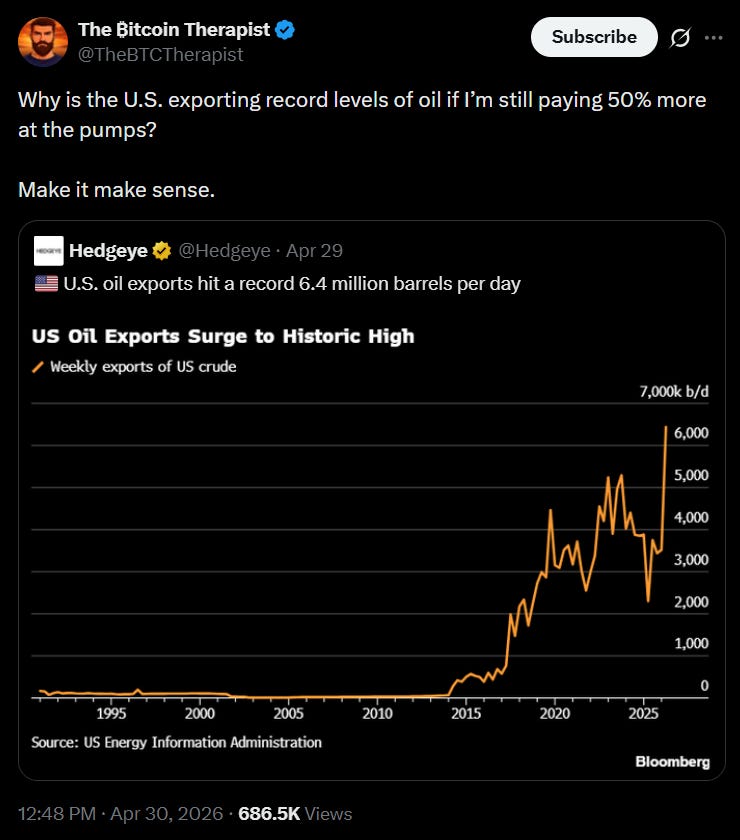
As noted in that report, a number of these exports were drawn upon from the strategic reserve, despite the fact that the current administration has not refilled them.

This trend has continued.
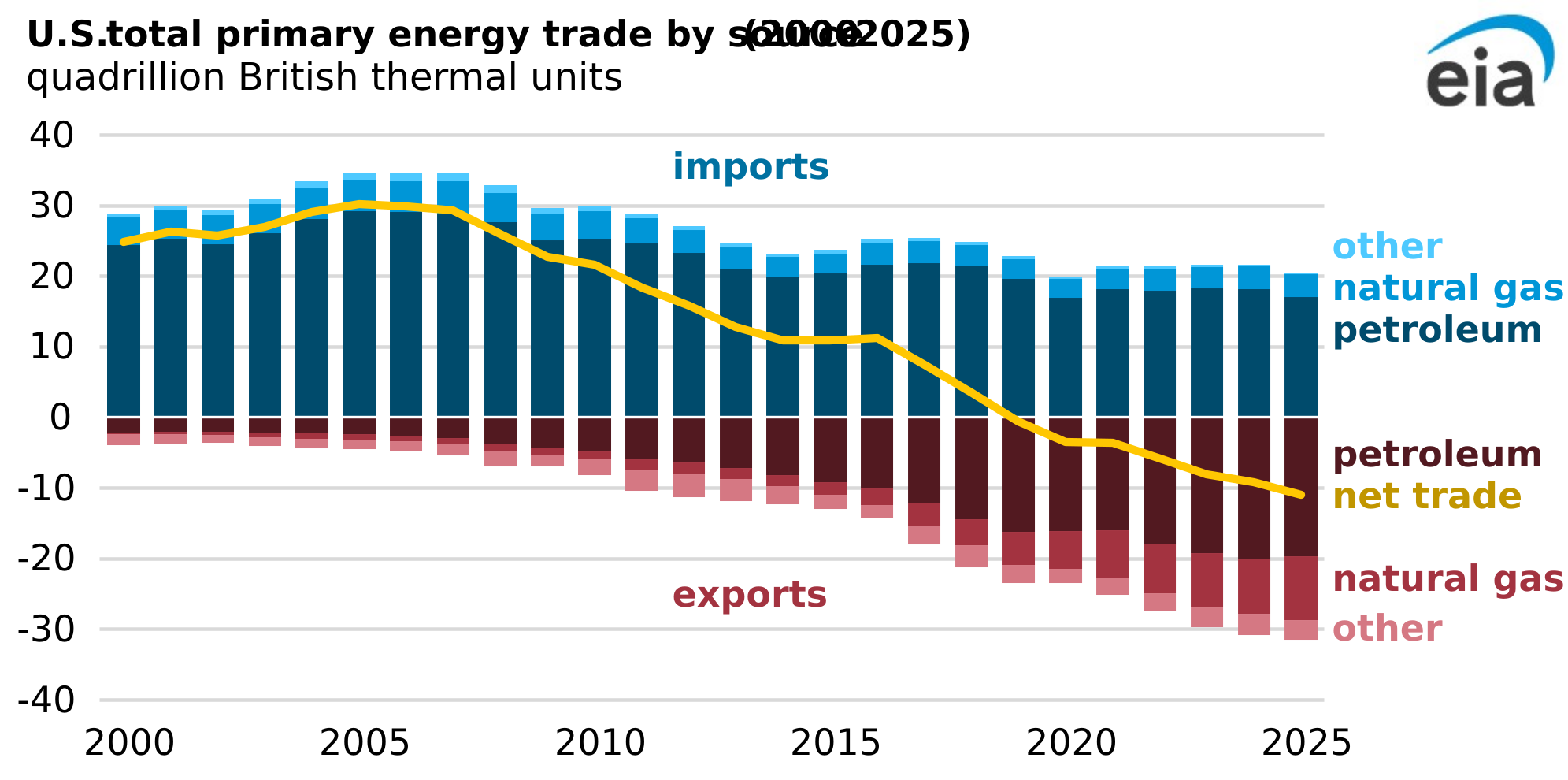
The Energy and Information Agency (EIA) reported on May 27th that The United States is a major energy exporter and importer, especially for petroleum.
Total energy exports from the United States reached a record 31 quadrillion British thermal units (quads) in 2025, 2% more than the previous record set in 2024. U.S. energy imports were 21 quads, down 5% from 2024. Taken together, net trade—total imports less total exports—reached 11 quads of net exports in 2025, a record and 20% more net exports than the previous record set in 2024.
Petroleum accounts for most U.S. energy trade and is the largest source of both exports and imports. U.S. petroleum exports remained near records in 2025, with most exports going to other countries in North America, Europe, and Asia.
The reserve continues to be emptied under Trump 2.0.
OilPrice.com reported on June 9th:
The American Petroleum Institute (API) estimated that crude oil inventories in the United States fell by 9.119 million barrels in the week ending June 5. Analysts had expected a 3.4 million draw. In the week prior, US crude oil inventories fell by 6.75 million barrels.
Despite inventories dropping by a hard-to-stomach 44 million barrels over the last 8 weeks according to API data, US crude inventories are still up almost 7 million barrels so far this year, according to API data.

Inventories in the US Strategic Petroleum Reserve (SPR) are also falling quickly as the Trump Administration looks to alleviate pricing pressure. For the week ending June 5, another 7.9 million barrels left the SPR, bringing the new total to 349.2 million barrels—the lowest level since August 2023 and 376 million barrels shy of maximum capacity.
US production slipped to 13.707 million bpd for the week ending May 29, down from 13.715 million bpd in the week prior, according to the latest EIA data, and up 299,000 bpd from a year earlier.
And again yesterday, the outlet noted:
Crude oil inventories in the United States decreased by 7.2 million barrels during the week ending June 5, according to new data from the U.S. Energy Information Administration (EIA) released on Wednesday. The decrease brings commercial stockpiles to 426.5 million barrels, according to government data, which is now 5% below the five-year average for this time of year.
The EIA’s data release follows API’s figures that were released a day earlier, which reported that crude oil inventories saw a draw of 9.119 million barrels in the period.
But the Trump administration appears committed to continue releasing more reserves and export more.
Again, as reported yesterday by OilPrice.com, the U.S. will export more oil to ASEAN bloc nations.
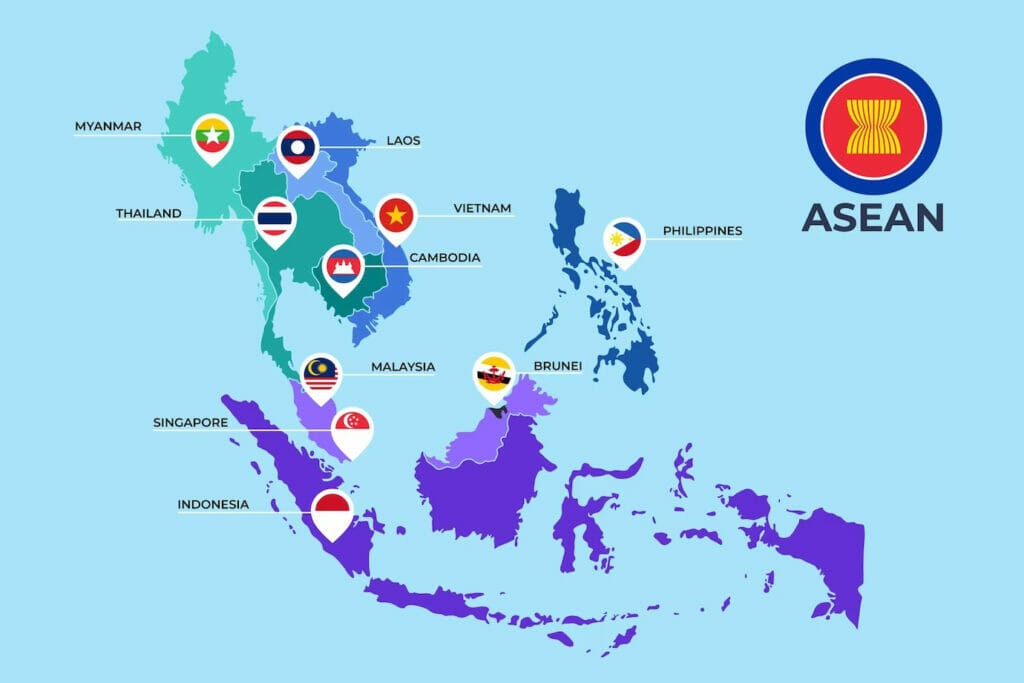
The United States will release liquefied natural gas and liquefied petroleum gas from its strategic reserves to sell to ASEAN members, Deputy Secretary of State Christopher Landau said today at an ASEAN event in Vietnam.
“The current energy crisis has clearly outlined the need for countries to diversify energy resources, and the United States wants to work with you to help ASEAN member states not only navigate the current situation, but also to support long-term energy security and resilience,” the U.S. official said, as quoted by Reuters.
Landau added that the United States was eager to boost its energy exports to the Asian group further and participate in energy infrastructure investments in the region as well. “The choices you all make today about infrastructure partners will shape your security and prosperity for decades to come,” he said. Landau also suggested cooperation between ASEAN and the United States on critical minerals investment, according to the Reuters report.
U.S. exports of liquefied natural gas have been on a strong rise this year, with the increase especially marked after the start of the war in the Middle East that took a solid portion of global flows offline. In March, LNG exports from the U.S. hit an all-time high of 11.6 million tons, with the bulk going to Europe, which has been scrambling to secure enough gas to make it through the winter and not see its storage depleted. April flows remained strong, but last month LNG exports dipped as plants entered maintenance.
Even with maintenance, however, LNG flows from the United States to Asia increased palpably in May, from April, reaching 3.68 million tons, up from 2.71 million tons in April. The May figure was the highest in 12 months, Reuters reported earlier this month, citing figures from LSEG.
This continued selloff and drawdown from the reserves has some investors and analysts spooked, as Semafor pointed out, because “fresh federal data made clear that total US oil reserves, including the SPR and privately-held stocks, had reached their lowest level since 2004.”
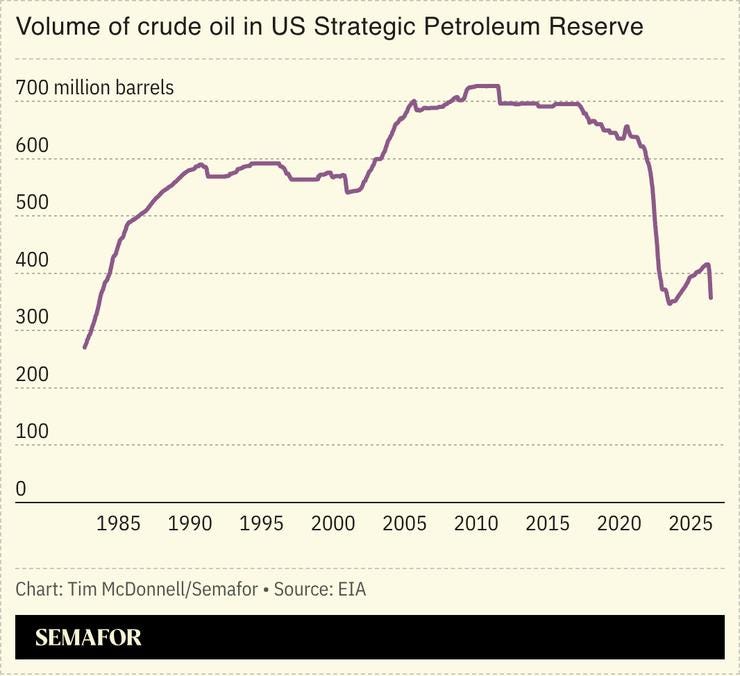
Tim McDonnell from Semafor reported:
US Energy Secretary Chris Wright told Fox Business he was “not concerned” about draining the SPR, because rather than “selling” barrels, the administration is signing swap contracts in which traders can take a barrel today with a commitment to return 1.25 barrels in the future. So far 133 million barrels have been contracted this way, a DOE spokesperson told Semafor, and are due to be returned “beginning early next year.”
On one hand, the oil producers are content because they gleefully sell higher and buy lower to make greater profit. But conversely, McDonnell writes, authorizing more releases would look like an admission of defeat in negotiations with Iran, and a clear vote of no-confidence from the government in its own strategy for reopening the strait. It would also push the SPR dangerously close to its legally-mandated operational minimum of 150 million barrels. The DOE spokesperson declined to comment on whether further releases are under consideration.
The biggest problem with more SPR releases is that they could backfire and send prices up, not down, Ben Cahill, senior fellow with the Atlantic Council Global Energy Center, told me. Promises of future replenishment notwithstanding, the only number the market really cares about is the SPR’s current level. “And at a certain point it becomes a self-defeating move,” he said, “because releasing more oil into the market is overwhelmed by the perception that we’re running out of options and have less slack.”
24/7 Wall Street also weighed in:
“The political bind is simple. Trump campaigned on refilling the reserve “right to the top.” The Energy Department sold SPR barrels near $75 during 2022 and 2023. Buying aggressively at $100 means booking public losses on every barrel, a narrative no administration wants to defend. So the department waits for prices to fall. While it waits, allies request supply, refiners negotiate swaps, and the stockpile continues to drain.
“[…] the volatility underscores a broader energy system under stress. A second shock, whether from Middle East escalation or domestic infrastructure failure, would hit an economy with a depleted oil reserve and limited slack in natural gas storage.
“The administration’s Iran policy will determine whether crude prices moderate enough to allow refill purchases later this year. Until then, the SPR continues to serve as a release mechanism, not a strategic stockpile.”
Meanwhile, the Trump administration and Congress are continuing to dilute the fuel supply with E15 ethanol. The WP noted that in March the EPA announced they would begin diluting the fuel supply with E15.
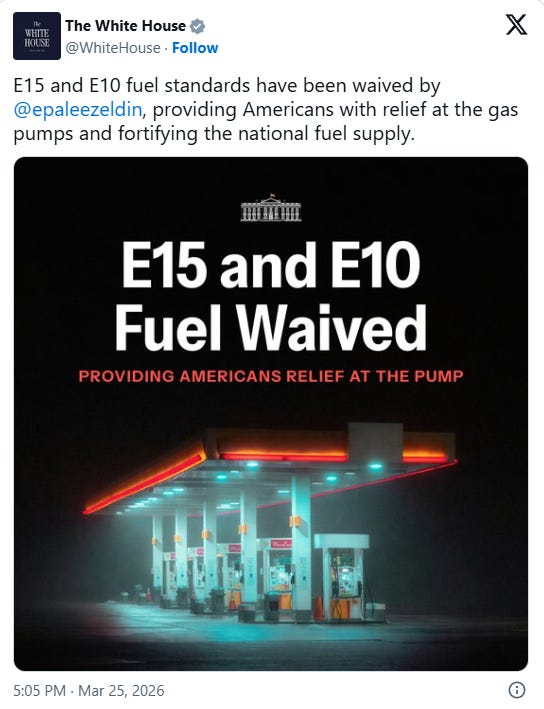

In May, Congress passed a bill to extend the release and sale of E15 at the pump, though the bill faces opposition in the Senate.
CSP reported last month:
The Nationwide Consumer and Fuel Retailer Choice Act of 2025, introduced in the House in February 2025, passed 218-203, according to Congress.gov. It would still need Senate approval and President Donald Trump’s signature to become law, and opposition is expected in the Senate, the Wall Street Journal reported.
The National Association of Convenience Stores (NACS), Alexandria, Virginia, has been an advocate for the year-round sale of E15.
“With gas prices remaining top of mind for American families, this legislation gives consumers more choices at the pump by removing an antiquated federal barrier to year-round E15 sales,” said Matt Durand, NACS deputy general counsel. “It means retailers nationwide would have the long-overdue option to sell E15 alongside other fuels, and we applaud the House for passing it on a bipartisan basis.”
However, the E15 may be limited to a small percentage of gas pumps, roughly 3%, mostly in the Midwest. However, there has been evidence to suggest fueling stations are quietly diluting the gas with ethanol.
As for around the world, other nations are increasingly tapping into their reserves as well, namely Japan and China in recent weeks; though China is best prepared for an energy shock as the country has been methodically stockpiling for years, OilPrice.com noted.
On top of this, in May, the UAE announced that they were leaving OPEC. In roughly a month’s time, the impact is being felt and OPEC’s production levels have fallen to their lowest since 2000. OilPrice.com highlighted:
Crude oil production among members of OPEC has this year collapsed to a generational low, at just 16.13 million barrels daily, Reuters reported, citing a regular survey it conducts on OPEC production. The amount is the lowest since 2000, the publication noted.
The May average is also lower than OPEC production at the height of the Covid lockdowns, when the reduction was prompted by the collapse in demand as a result of the lockdowns. It is worth noting, however, that the May OPEC figure excludes the UAE, which left the group as of the first of that month.
Iran suffered the greatest loss of production, according to the Reuters survey, with exports falling to the lowest in six years as a result of the U.S. naval blockade in response to Iran’s closure of the Strait of Hormuz. The closure, in turn, affected other Gulf states’ production.
All in all, the IEA projects a drop in global oil demand that will limit price increases from Hormuz disruptions.
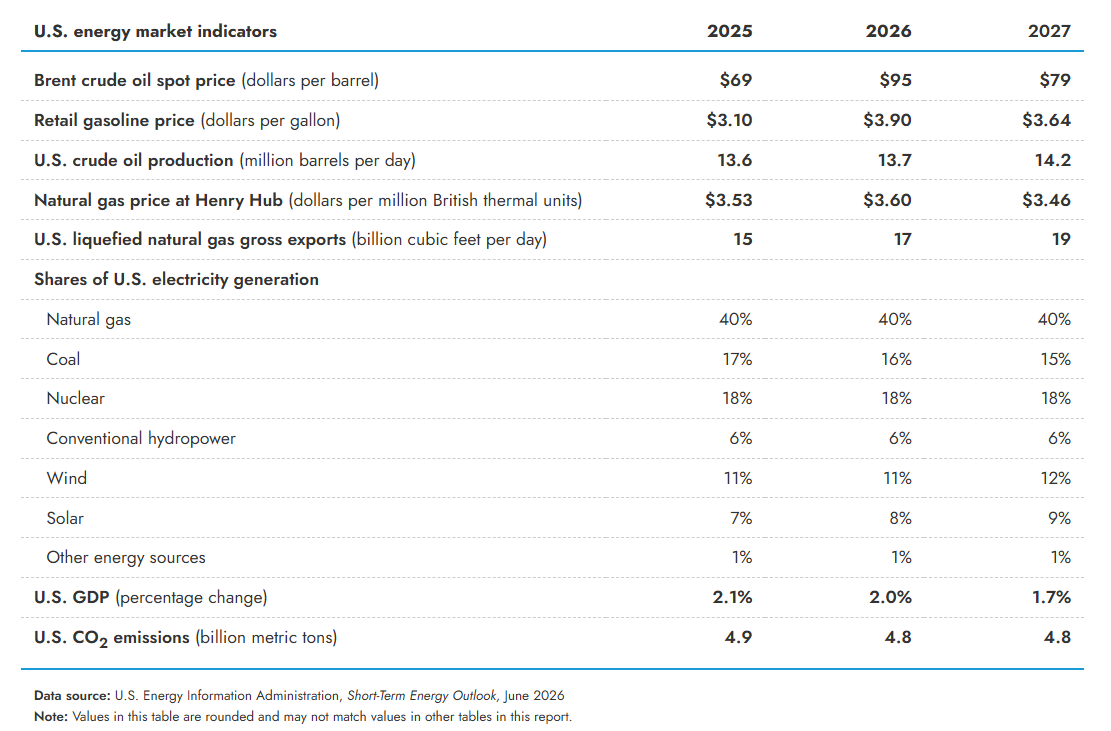
The U.S. Energy Information Administration published its June Short-Term Energy Outlook (STEO), reducing its expectation for global oil demand in 2026. High fuel prices, reduced fuel availability, and government initiatives are curbing oil consumption this year, particularly in Asia, resulting in the world consuming 1 million fewer barrels of oil each day on average than it did last year. The reduced demand could limit crude oil price increases resulting from near-term disruptions in the flow of oil out of the Middle East through the Strait of Hormuz.
“Any scenario involving full restoration of inventories, production, and trade flows to pre-conflict levels must account for the partial restructuring of the global oil market that has already occurred,” EIA Administrator Tristan Abbey said.
AUTHOR COMMENTARY
Proverbs 11:18 The wicked worketh a deceitful work: but to him that soweth righteousness shall be a sure reward.
As I have said repeatedly since March, on the 6th anniversary of when Trump declared Covid-19 an emergency and the initial 15 Days to Stop the Spread, we are seeing a repeat of similar lockdown measures.
The “war” in Iran is about climate lockdowns the UN’s, WEF’s green and low-carbon agenda; resulting in significantly less shipping, foreign and domestic travel, food shortages and famine, collapsed supply chains, and greater enforcement of “green” technologies. The marketing may have changed (as we have seen with the push for datacenters and the overt ESG messaging being scrapped), but the fundamental schemes and principles have not changed.


The headlines we have covered since March prove this; and once you see it it is hard to unsee it. That’s why this war, just like the Ukraine war, will continue to drag on and on until it doesn’t.
As detailed in this report, the reasons for oil prices staying lower than many analysts expected are simple:
One, oil producers and the moneychangers are artificially keeping it down a bit (in my opinion); two, because Trump and other nations are draining their reserves (something Trump notably has not really touted because it would shine a light on failed policy, and his administration out Americans again); and three, because nations are already adjusting for lower demand.
That being said, how much longer can this go on before prices rip higher, once reserves simply get too low, and other straits and trade routes around the world come under fire and closure (and they will, that’s my prediction at least)?
It is a deliberate and tearing down of the old system so the new one of greater compliance and subjugation can be installed.
Maybe we can all start driving Barbie cars to the store…
If you enjoy this report and others like it, please consider sharing this post and supporting The WinePress down below!
The Lord Of Glory: The Detailed Guide To Who God Is – Available Now!

On one of his missionary journeys, the apostle Paul visited Athens, Greece, where he said he witnessed “the city wholly given to idolatry,” and who were “too superstitious” and worshipped a plurality of gods and deities, though the people acknowledged that there was still one God above all that was a mystery to them. When questioned by the philosophers …
[7] Who goeth a warfare any time at his own charges? who planteth a vineyard, and eateth not of the fruit thereof? or who feedeth a flock, and eateth not of the milk of the flock? [8] Say I these things as a man? or saith not the law the same also? [9] For it is written in the law of Moses, Thou shalt not muzzle the mouth of the ox that treadeth out the corn. Doth God take care for oxen? [10] Or saith he it altogether for our sakes? For our sakes, no doubt, this is written: that he that ploweth should plow in hope; and that he that thresheth in hope should be partaker of his hope. (1 Corinthians 9:7-10).
The WinePress needs your support! If God has laid it on your heart to want to contribute, please prayerfully consider donating to this ministry. If you cannot gift a monetary donation, then please donate your fervent prayers to keep this ministry going! Thank you and may God bless you.
To support The WinePress, you can contribute by doing one or more of the following:
You may send cash, check or letters to this address:
Jacob M. Thompson
#119
12820 Adams Rd.
Granger, IN 46530
If you decide to send a check, please do not address it to “The WinePress.” Please address it to the name listed.
You can become a paid member on Substack.
You can also donate electronically by hitting the link below:
bet there's some insider trading going on just like the iran war
"straits are open now, woops, they're closed again"
Revelation 6 coming in real time. Body of Christ is removed prior. The covenant of the many will trigger the tribulation. We are not here for that. Thank you.